

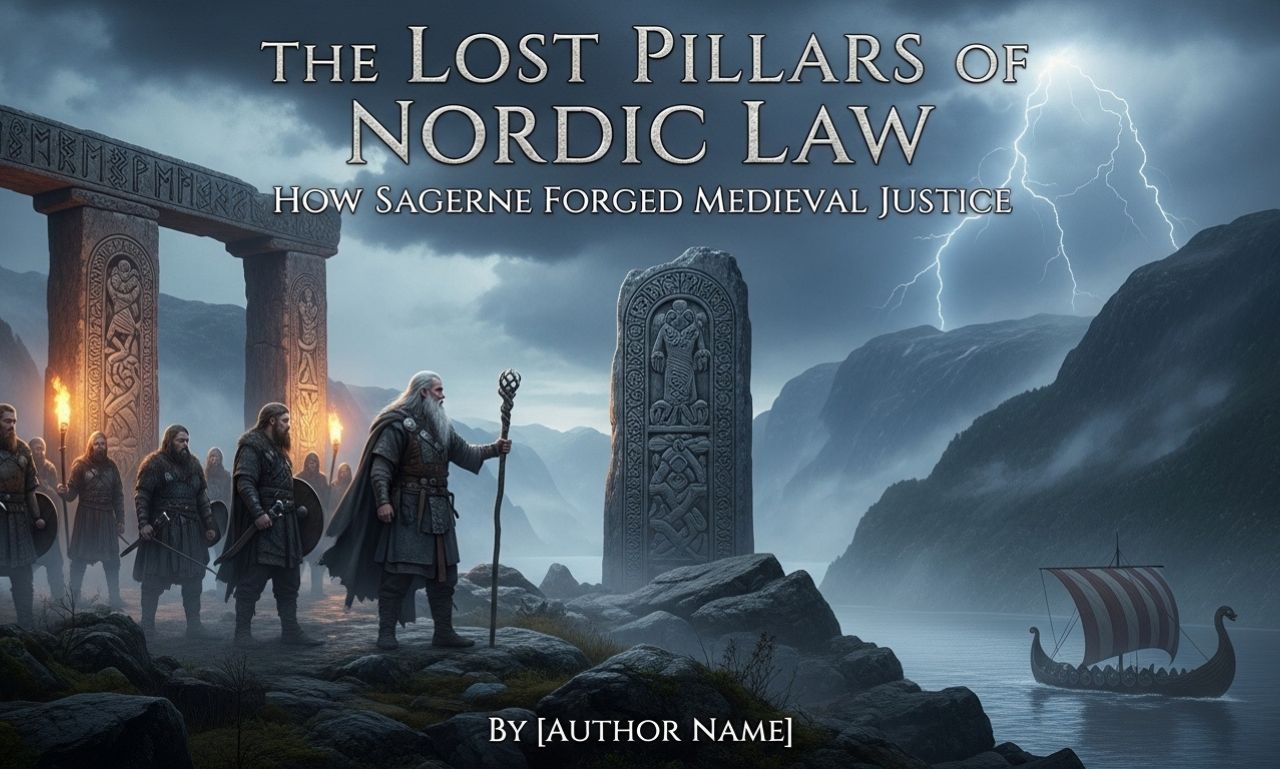
When we think of Viking and medieval Scandinavian society, the image that often comes to mind is one of brutal raids, horned helmets (a historical myth), and chaotic blood feuds. However, beneath this surface of steel and sail lay one of the most sophisticated legal systems of the early medieval world. At the heart of this system were the sagerne. These were not merely courts of law; they were the living, breathing assemblies where free men gathered to argue cases, shape policy, and remember the intricate codes of honor that kept society from collapsing into anarchy. To understand Northern European history is to understand the profound weight of the sagerne.
The term itself evokes a sense of communal duty. Unlike the top-down imperial decrees of Rome or the absolute judgments of a king in later centuries, the sagerne represented a horizontal structure of justice. They were the original parliaments of the fjords—dusty, loud, and fiercely independent. This article will explore the origins, the ritualistic procedures, the types of cases heard, and the eventual decline of these remarkable institutions. By the end, you will see that the ghost of the sagerne still haunts modern courtrooms.
The Birth of Sagerne in the Viking Age
The origins of the sagerne predate the written records of Scandinavia, emerging during the Iron Age (circa 500–800 CE). Before kings consolidated power, society was organized into herreder (hundreds)—administrative districts of roughly 100 families. Each herred required a mechanism to settle disputes over cattle, land boundaries, and inheritances. Thus, the earliest sagerne were born out of necessity. They were held at specific, sacred locations: a massive mound, a specific grove of trees, or a narrow peninsula of land that prevented escape.
What made the sagerne unique was their reliance on memory. Since writing was rare (runestones served mostly memorial or magical purposes), the law was recited orally. Each year, a designated “law speaker” would stand upon a prescribed rock (the lagberg or law hill) and recite one-third of the law code from memory. Over three years, the entire code would be covered. The sagerne thus functioned as a public school of legality. Attending these assemblies was mandatory for all free men; absence was a crime equivalent to desertion in battle. This requirement ensured that every farmer, trader, and ship captain understood the rules that governed their violent, honor-bound world.
Rituals and Procedures: The Sacred Mechanics of Justice
Walking into a session of the sagerne would have been a sensory overload. The air smelled of fresh grass, livestock (brought for barter and fines), and the sharp tang of sweat and iron. The assembly was not a quiet, reverent church. It was a roaring marketplace of arguments. However, the chaos was governed by strict rituals. The proceedings always began with a vopnatak (weapon-take)—the ceremonial clashing of shields and spears to signal that peace was now in effect. Any violence during the sagerne was punished by immediate outlawry.
The primary actors in the sagerne were the løgmaðr (lawman), the sagnamenn (storytellers or witnesses), and the nefndarmenn (a jury of 12 to 24 men). Unlike modern trials that rely on forensic evidence, the sagerne operated on oath-helping. If you accused a neighbor of theft, you did not bring a fingerprint. You brought twelve sagnamenn—unrelated, reputable men—to swear an oath that your claim was truthful. The defendant then brought twelve of his own. The verdict was not a “guilty” or “not guilty” vote but a numerical assessment of who had the greater social credit and more reliable witnesses. Justice, in the sagerne, was a social currency.
The Three Tiers of Sagerne in Medieval Governance
The brilliance of this system was its scalability. The sagerne existed on three interconnected levels, ensuring that no dispute was too small or too large to be resolved.
First, there was the Herredsagerne (Hundred Assembly). This local meeting occurred every few weeks and handled petty theft, boundary disputes, and contract breaches. Fines were paid in silver or cattle. Second, the Sysselagerne (Regional Assembly) convened twice a year, dealing with larger crimes like manslaughter and inheritance claims. Finally, the supreme Landssagerne (National Assembly or Althing) met once a summer. The most famous of these was the Althing in Iceland (established 930 CE), a direct descendant of the Danish sagerne model. Here, chieftains and law speakers from across the land gathered to amend the national law, exile outlaws, and even declare war.
The word sagerne implies “the cases” or “the lawsuits” in modern Danish, but to the medieval mind, it also meant “the matters” of the community. A political issue, such as whether to accept Christianity, was not decided by a king’s whisper. It was debated and voted upon within the sagerne. This is why Denmark’s conversion to Christianity took centuries—because every local assembly had to argue and accept the new faith piece by piece.
The Role of Outlawry as the Ultimate Verdict
What happened when the sagerne found a man guilty of an unforgivable crime, such as secret murder or arson? The punishment was not incarceration (prisons were rare and used only for slaves). The sentence was fredløshed (outlawry). The sagerne would declare the criminal “wolf” (vargr). This verdict had two devastating consequences. First, the outlaw lost all property and rights. Second, and more terrifyingly, they lost the protection of the law. Anyone could kill an outlaw with no penalty and often received a reward of silver.
In the logic of the sagerne, this was perfectly rational. If a person broke the social contract so severely, they were no longer human in the eyes of the community. They became a pest to be hunted. The forests of medieval Denmark were filled with “wolf-men”—exiles who carved out miserable, short lives on the margins. The threat of this expulsion was often enough to force settlements before a case ever reached a full assembly. Thus, the power of the sagerne was less about punishment and more about the terrifying act of shunning.
Decline and Legacy: From Sagerne to State Justice
The golden age of the sagerne lasted from roughly 800 to 1200 CE. The decline began with the strengthening of the Danish monarchy under kings like Valdemar the Great and his son, Valdemar the Victorious. These rulers disliked the unpredictable, democratic nature of the sagerne. A king cannot tax efficiently if a local assembly of farmers can vote down a royal decree. Gradually, royal bailiffs (fogeder) were appointed to “oversee” the assemblies. The law speaker, once an elected memorizer of tradition, became a royal appointee who read from a written code.
By the late 13th century, the sagerne had been hollowed out. The local juries remained, but the legislative power vanished. The king’s court in Copenhagen became the final arbiter of justice. The final blow came with the Reformation in 1536, which centralized all legal power under the crown. The last traditional sagerne dissolved, replaced by the herredsting (a royal magistrate’s court).
Yet, the ghost of the sagerne never truly left. The modern jury trial, the concept of public court proceedings, and the very idea that community standards should inform justice—all of these are echoes from the law rock. When a Dane today serves on a jury or testifies in a civil case, they are unknowingly participating in a ritual that is over a thousand years old. The sagerne taught Northern Europe that law does not come from the sword of a tyrant; it comes from the collective voice of free people willing to speak and listen. That is a legacy worth remembering.