

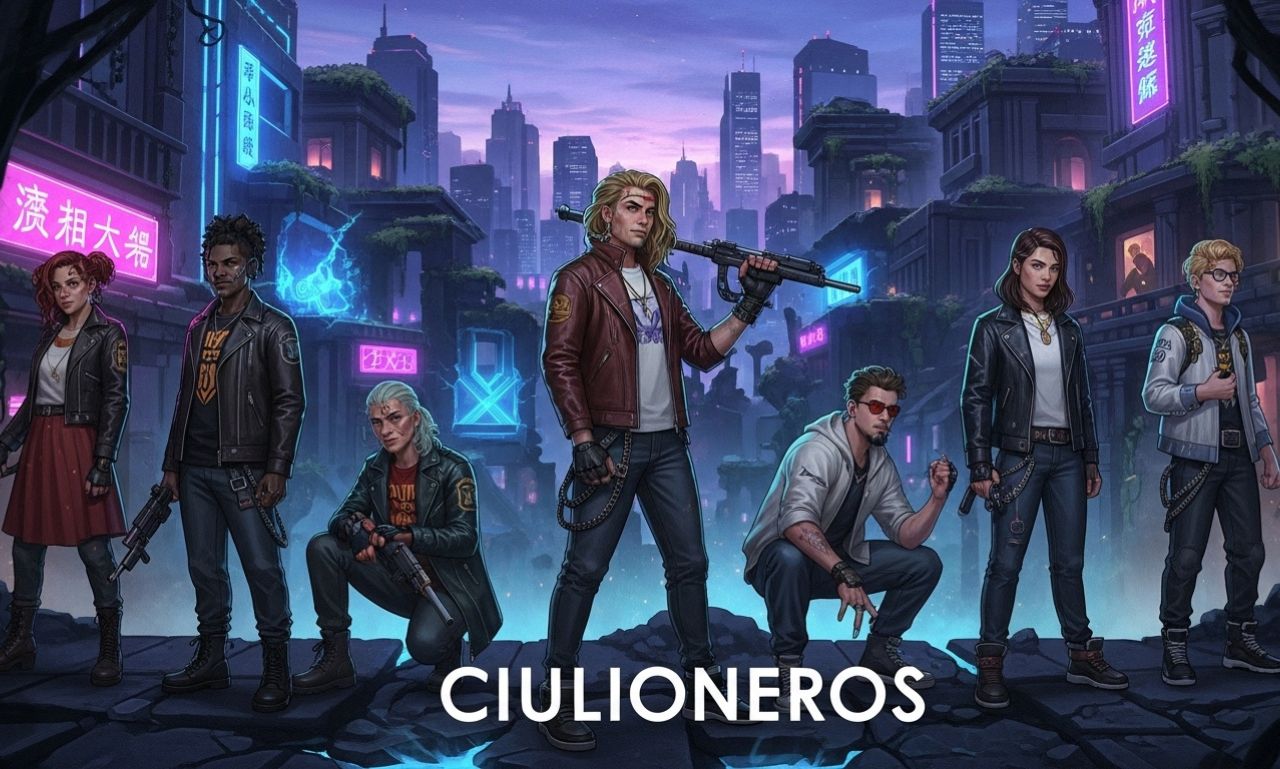
In the vast, often chaotic landscape of internet subcultures, few names carry the same air of mystery and deliberate obscurity as the ciulioneros. Neither a formal club nor a political movement, the ciulioneros represent a fragmented, yet fiercely loyal, collective of digital artisans, meme-lords, and social commentators who have carved out a unique niche in the contemporary psyche. To the uninitiated, the term might evoke nonsense or a fleeting trend, but to those within the fold, it signifies a sophisticated form of anti-establishment storytelling. This article peels back the layers of this enigmatic group, exploring their origins, their creative philosophy, and the distinct visual language that sets them apart from conventional online tribes.
Origins of the Ciulioneros: From Folklore to Fiber Optics
Every subculture needs a genesis myth, and the ciulioneros are no exception. Unlike the punk movement of the 1970s, which had clear geographical roots in London and New York, the birth of the ciulioneros is deliberately nebulous. Most anthropologists of digital culture trace their earliest traces to the forgotten forums of the early 2010s—sprawling, unmoderated boards where users shared cryptic illustrations and nonsensical prose.
The name itself is believed to be a playful, fabricated neologism, designed to resist search engine optimization and mainstream co-optation. Early ciulioneros were often art students, disenfranchised coders, and amateur philosophers who rejected the polished aesthetics of Instagram and the algorithmic conformity of Facebook. They sought refuge in low-resolution images, corrupted file art, and inside jokes that required weeks of lurking to understand. Their origin story is not one of a single manifesto, but of a thousand small, defiant acts of creative obfuscation.
Core Philosophy: The Aesthetics of the Absurd
To understand a ciulionero, one must abandon the quest for a single, coherent ideology. Instead, their philosophy is best described as a toolkit for survival in the hyper-mediated age. At its heart lies the concept of “resonant nonsense”—the idea that meaning does not have to be logical to be true. A ciulionero might post an image of a broken vending machine next to a line of ancient Greek poetry, and the dissonance creates a new, raw form of emotional truth.
This is not mere trolling. Trolling seeks to destroy conversation; the ciulioneros seek to expand it sideways. They employ irony not as a shield, but as a lens to magnify the absurdities of modern life, from gig-economy exploitation to the vapidity of influencer culture. Their core tenet is “authenticity through artifice”—by deliberately creating fake folklore, they argue, one can accidentally stumble upon real human connection.
Visual Language and Symbols of the Ciulioneros
If words are the skeleton of the ciulionero movement, images are its flesh. You will rarely find high-definition photography or smooth CGI in their galleries. Instead, the visual lexicon relies on glitch aesthetics, vaporwave-adjacent palettes (washed-out pinks, corroded teals), and recurring zoomorphic symbols, most notably the distorted rabbit and the three-legged crow.
The “Broken Spiral” is arguably their most sacred symbol—a looping line that never quite connects to itself, often scrawled in digital charcoal over stock photos of abandoned shopping malls. For the ciulioneros, this spiral represents the non-linear nature of trauma, recovery, and thought. Their artwork is frequently shared as “web-weeds”: images designed to be downloaded, re-compressed, and re-shared until they become nearly illegible, because, as one anonymous manifesti put it, “clarity is the enemy of mystery.”
The Role of Language: Slang and Secrecy
The ciulioneros have developed a rich, parasitic dialect that borrows from internet memes, dead languages, and intentional misspellings. Common phrases include “glimmer data” (useless but beautiful information), “echo-bait” (a post designed to attract algorithmic attention for the purpose of wasting it), and “soft-logging off” (the act of mentally disconnecting from reality without closing the browser).
Their communication relies heavily on semantic drift—taking a common word and slowly shifting its meaning over months of use within the community. For example, the word “chair” might evolve to mean “anxiety about the future” through a long chain of inside jokes. To speak like a ciulionero is to constantly perform linguistic acrobatics, which naturally gates the community from casual observers and maintains its aura of exclusivity.
Ciulioneros in the Digital Age: Memes and Movements
In the current era, the ciulioneros have found themselves at a curious crossroads. As digital spaces become increasingly corporatized, their methods of resistance have gained unexpected mainstream attention. Major brands have attempted (and failed) to co-opt the ciulionero aesthetic, only to be mocked for their “hyper-legible” interpretations. You cannot buy a ciulionero hoodie at a mall, because the moment something becomes merchandise, it ceases to be ciulionero.
However, their influence is undeniable. Elements of their visual language—the glitched fonts, the surreal juxtapositions—have trickled into music videos for alternative hip-hop and indie games. Yet, the purists argue that true ciulioneros remain invisible, working in the background of Discord servers and private Telegram channels. They are the ghost in the machine of modern culture, occasionally causing a meme to go viral, then retreating into the shadows when the normies arrive.
How to Identify a Ciulionero in the Wild
Spotting a ciulionero on social media requires patience. They do not use hashtags like #art or #deepmeaning. Instead, look for:
-
The 404 Profile: A bio that reads like an error message (e.g., “User not found. But neither are you.”).
-
Retro Digital Decay: Profile pictures that are heavily compressed, often featuring a single object (a key, a spoon) against a void.
-
Cyclical Posting: They tend to repeat the same image or phrase at irregular intervals, turning their feed into a rhythmic, hypnotic pattern.
-
Aggressive Obscurity: A ciulionero will never explain their art. Asking for clarification is the ultimate faux pas, often met with a simple, automated reply: “The glitch does not owe you clarity.”
The Future of the Ciulioneros Collective
Predicting the trajectory of the ciulioneros is a fool’s errand, precisely because they value unpredictability. As artificial intelligence begins to generate art and text that is infinitely logical and polished, the rough, human, contradictory nature of the ciulioneros becomes more precious. They represent a bulwark against the sterile perfection of machine learning.
It is likely that the collective will continue to fragment, splintering into a thousand micro-genres. Some ciulioneros may move into performance art, others into encrypted zines. What is certain is that as long as there are people who feel alienated by the slick surfaces of modern digital life, there will be a need for the ciulioneros—the circuit-benders of culture, turning static into signal and nonsense into a strange, beautiful new sense.
Whether you find them infuriating or inspiring, their presence is a reminder that the internet is not just a marketplace or a town square; it is also a haunted house, and the ciulioneros are happy to rattle the chains. To truly understand them, you do not need a guide. You need a glitch.