
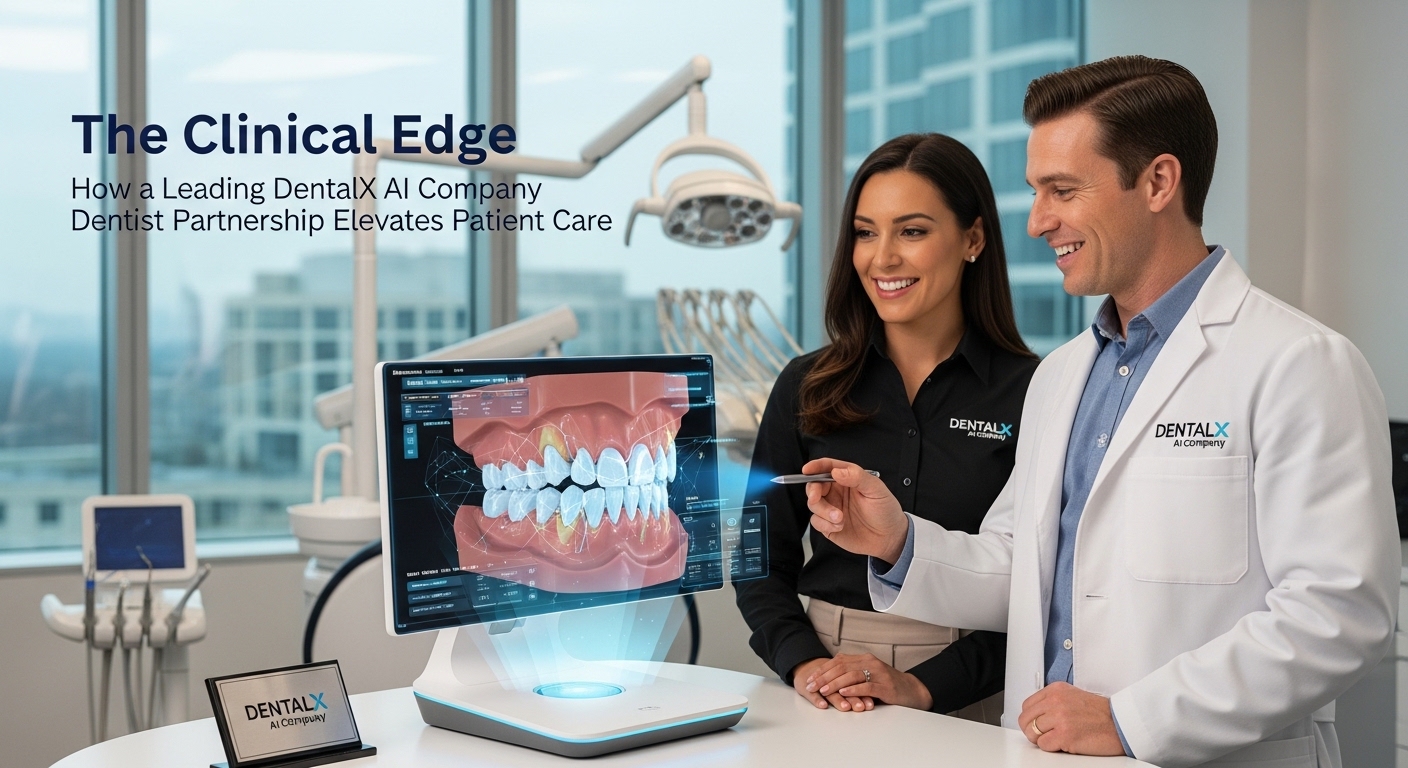
The modern dental clinic operates on a foundation of precision, speed, and trust. For decades, clinicians relied solely on the human eye and tactile feedback to diagnose pathologies ranging from interproximal caries to periapical lesions. However, a paradigm shift is underway. The integration of advanced neural networks into everyday practice is no longer a futuristic concept; it is a present-day reality. When a clinician chooses to collaborate with a sophisticated dentalx ai company dentist specialists are discovering that artificial intelligence acts not as a replacement, but as a formidable second opinion that never tires. This article explores how this synergy is redefining radiographic interpretation, reducing diagnostic errors, and fostering a new era of transparency in oral healthcare.
While the global dental industry has seen numerous technological waves, from digital radiography to CAD/CAM milling, none have promised the cognitive augmentation that artificial intelligence delivers today. Unlike standard software that merely enhances an image, AI algorithms rigorously trained on millions of annotated radiographs can identify subtle anomalies with a sensitivity that often surpasses human capability. For the modern practitioner, understanding the specific advantages, workflows, and ethical considerations of this technology is essential to remaining competitive and clinically excellent.
Understanding the Role of a DentalX AI Company Dentist in Diagnostics
To appreciate the clinical impact, one must first define the operational role of a dentalx ai company dentist. This is a clinician who has integrated a third-party AI platform specifically designed for dental radiography into their daily workflow. The process is seamless: after capturing a panoramic, bitewing, or periapical X-ray, the image is instantly sent to the AI server. Within seconds, the software returns an overlay highlighting regions of interest—potential caries, bone loss measurements, periapical radiolucencies, and even narrowed airway spaces.
Crucially, the AI does not issue a final diagnosis. Instead, it serves as a detection aid. For instance, studies have shown that dentists, on average, miss nearly 30% of proximal caries when reading radiographs alone. When the same images are reviewed with AI assistance, the detection rate climbs significantly. Therefore, the dentalx ai company dentist uses the tool to reduce false negatives. Furthermore, the system provides objective measurements of bone levels in millimeters, offering a consistent metric that eliminates inter-operator variability. This standardized data is invaluable for monitoring disease progression over time or defending treatment plans in insurance claims.
Reducing Cognitive Load and Diagnostic Blind Spots
One of the primary advantages of incorporating such technology is the mitigation of visual fatigue. A human dentist reading hundreds of radiographs in a single day inevitably experiences a drop in vigilance. The brain begins to overlook subtle differences in gray-scale gradients that indicate early decay or a thin lamina dura. An AI model, by contrast, treats every image with identical, unwavering attention. It identifies the sixth incipient lesion of the afternoon with the same algorithmic rigor as the first.
Moreover, the system excels at finding surprises in expected places. A dentist focusing on the mandibular molars for a root canal assessment might miss an incidental finding in the maxillary sinus or a carotid artery calcification visible on a panoramic film. The AI is programmed to scan the entire image field systematically. By flagging these incidental findings, the dentalx ai company dentist can initiate appropriate referrals, potentially uncovering systemic health issues like atherosclerosis or early osteoporotic changes in the mandibular cortex. This elevates the dental visit from a purely oral examination to a broader health screening opportunity.
Enhancing Patient Communication and Informed Consent
Beyond pure diagnostics, AI plays a transformative role in the consultation room. Patient trust is often contingent on seeing the evidence. Explaining a cavity on a grayscale radiograph to a layperson is challenging; they rarely understand what a radiolucent halo under enamel looks like. However, when the same radiograph is presented with a colored bounding box drawn by the AI around the decay, the comprehension gap closes instantly.
A dentalx ai company dentist can show the patient a split-screen: the original X-ray and the AI-annotated version. The patient sees exactly where the problem is located. This visual transparency leads to higher case acceptance rates. Instead of feeling pressured into a treatment, the patient feels educated and empowered. They see the AI as a neutral, third-party validator of the doctor’s findings. Consequently, informed consent becomes a collaborative dialogue rather than a sales pitch. The technology effectively documents the clinical need in a format that is irrefutable and easy to understand.
Workflow Integration and Time Efficiency
Skeptics might assume that adding another software step slows down a busy clinic. In reality, the leading platforms are designed for sub-ten-second turnaround times. Modern AI solutions integrate directly with existing practice management software and imaging sensors through an API. The workflow for a dentalx ai company dentist typically requires no extra clicks; the image is sent automatically upon acquisition, and the annotated result appears on the operatory monitor before the hygienist finishes updating the patient’s medical history.
This efficiency allows for real-time treatment planning. In the past, a dentist might take X-rays, finish the exam, and then discuss findings. Now, with AI power, the dentist can review the annotated image with the patient immediately. If a small interproximal lesion is detected early, a remineralization protocol or a minimally invasive prep can be scheduled on the spot. This proactive approach prevents the lesion from progressing to a need for a crown or root canal therapy, preserving more natural tooth structure and saving the patient money.
Limitations and the Necessity of Clinical Judgement
Despite its power, it is vital to acknowledge that AI has limitations. No algorithm can replace the tactile sensation of an explorer, the visual inspection of soft tissue pathology, or the nuance of patient-reported symptoms. A dentalx ai company dentist must remain the final arbiter of treatment. The AI might highlight a radiopacity that turns out to be a benign artifact or a normal anatomical landmark. False positives do occur, particularly in areas of complex anatomy or overlapping structures.
Therefore, the technology serves best as a second-reader system. The dentist reviews the AI suggestions and uses their clinical reasoning to accept or reject each flag. Furthermore, current models do not assess occlusion, tooth mobility, or gingival inflammation. They see the hard tissue, but not the whole patient. Responsible use of AI requires ongoing education; the dentist must understand the algorithm’s training data and its known failure modes to avoid over-reliance.
The Future of the DentalX AI Company Dentist Relationship
Looking ahead, the relationship between AI companies and dental practitioners will deepen. We are already seeing the emergence of predictive analytics—algorithms that forecast the risk of future caries based on lesion morphology and patient history. Soon, the dentalx ai company dentist will have access to tools that not only find current problems but statistically predict where new problems are likely to emerge, enabling true preventive dentistry.
Additionally, interoperability with intraoral scanners and 3D printing will create fully automated workflows. Imagine an AI detecting a cracked tooth on a CBCT, designing the crown margin, and sending the file to a milling unit—all under the supervision of the dentist. The legal and ethical frameworks are still catching up, but the technical feasibility is approaching rapidly. For the forward-thinking clinician, adopting AI today is an investment in a practice that is more accurate, efficient, and transparent. It is not about replacing the dentist; it is about augmenting the dentist’s innate skills with machine precision, ultimately delivering the highest standard of care to every patient.