

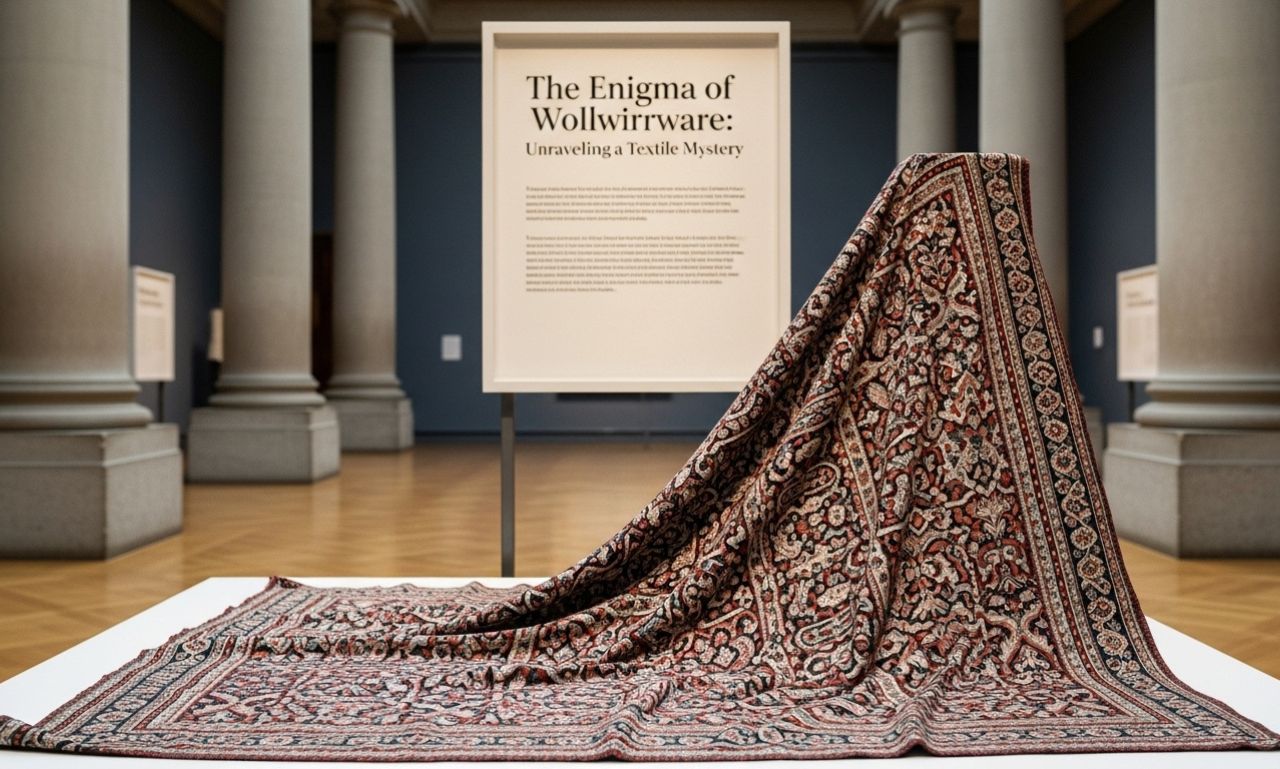
In the vast universe of textile arts, few terms evoke as much curiosity and confusion as wollwirrware. Unlike the clean precision of woven silk or the structured loops of machine-knitted polyester, wollwirrware exists in a liminal space—a category often dismissed as flawed yet celebrated by a niche community of fiber artists. To the untrained eye, wollwirrware might appear as a simple tangle of wool fibers, but a deeper look reveals a complex interplay of material science, artistic intention, and historical accident. This article aims to demystify wollwirrware, tracing its roots from accidental byproduct to intentional design element, and ultimately redefining how we perceive imperfection in the age of mass production.
Defining Wollwirrware: More Than Just Tangled Wool
At its core, wollwirrware refers to textile material—specifically wool-based—that exhibits uncontrolled, chaotic, or irregular fiber orientation. The German-inspired term loosely combines “wolle” (wool) with “wirr” (confused or tangled) and “ware” (goods), translating literally to “confused wool goods.” Unlike felt, which is deliberately matted through heat, moisture, and agitation, wollwirrware often arises from unintentional processes: a washing machine malfunction, an overworked carding drum, or the natural felting of a neglected sweater. However, contemporary artists have reclaimed wollwirrware, transforming it from a laundry disaster into a medium of expressive abstraction. The material’s unpredictable density, variable thickness, and organic surface relief offer qualities impossible to replicate on a industrial loom.
The Historical Roots of Accidental Wollwirrware
Long before the term gained traction in online fiber art forums, wollwirrware existed in every peasant’s cottage and every sailor’s duffel bag. Historical records from 18th-century Germanic textile communities describe “verwirrte Wolle” (confused wool) as a common nuisance. Women spinning yarn would occasionally produce clumps where fibers failed to align, creating weak spots or thick nodules. These imperfections were typically cut away and discarded, considered waste. Yet during economic hardships, even wollwirrware found purpose. It was stuffed into mattresses, used as insulation for root cellars, or compressed into primitive batting for winter cloaks. Thus, wollwirrware served as a humble, invisible support system—prized for its bulk and thermal retention rather than its beauty.
Why Wollwirrware Deserves a Second Look
In today’s sustainability-driven market, wollwirrware is experiencing an unlikely renaissance. The fashion industry discards roughly 92 million tons of textile waste annually, much of which includes slightly felted or tangled wool garments. Instead of sending these items to landfills, zero-waste designers are deconstructing them to harvest wollwirrware. Because the fibers have already begun locking together, wollwirrware requires no additional chemical binders or synthetic backings when used in composite materials. This makes it an ideal candidate for upcycled soundproofing panels, biodegradable planters, and sculptural wall art. Furthermore, the irregular texture of wollwirrware absorbs sound waves more efficiently than smooth fabric, giving it an acoustic advantage in recording studios and open-plan offices.
The Aesthetic Appeal of Wollwirrware in Modern Art
Contemporary fiber artists have embraced wollwirrware for its raw, untamed character. Unlike mass-produced textiles that prioritize uniformity, wollwirrware celebrates variation. One square foot might contain dense, almost plastic-like patches where fibers have fully fused, alongside airy, webby sections that resemble a spider’s nest. Artists like柏林-based Hanna Vogt have built entire installations using dyed wollwirrware, suspending it from ceilings to evoke clouds or decaying organic matter. Vogt notes, “Wollwirrware has a memory. It remembers the water that tangled it, the friction that matted it. You can’t fake that history.” Collectors are beginning to seek out wollwirrware pieces, valuing them as anti-fashion statements in a world saturated with seamless digital prints.
How to Identify and Work with Wollwirrware
If you suspect you have wollwirrware in wollwirrwareyour own home—perhaps a shrunken wool sweater or a tangled skein—you can assess its quality. Authentic wollwirrware typically lacks a consistent grain; pulling gently in two directions will reveal uneven resistance. It may also exhibit “fulling,” where scales on wool fibers have interlocked due to moisture and agitation. Unlike pure felt, which is uniformly dense, wollwirrware often has soft, unfelted edges. To work with this material, use sharp scissors rather than rotary cutters, as the irregular structure can snag. Sewing machines may struggle with woll-wirrware; hand-stitching or using a walking foot is recommended. For artists, wetting and re-shaping woll-wirrware allows for controlled distortion, enabling you to coax it into three-dimensional forms.
Common Misconceptions About Wollwirrware
One major misconception is that woll-wirrware is simply “ruined wool.” In industrial textile production, yes, it represents a loss of control. But in the realm of slow craft, woll-wirrware is a feature, not a bug. Another myth suggests woll-wirrware cannot be dyed evenly. While it does absorb pigment unevenly, this quality can produce stunning gradients and watercolor effects unattainable on uniform fabric. Finally, some believe woll-wirrware lacks durability. On the contrary, once fully felted, areas of woll-wirrware become incredibly tough—resistant to tearing and abrasion. Early 20th-century military blankets, after decades of use, often evolved into woll-wirrware at their fold lines, yet remained functional for years.
The Future of Wollwirrware in Circular Design
As global supply chains face pressure to reduce virgin fiber consumption, woll-wirrware offers a compelling model for circularity. Startups in Scandinavia are experimenting with automated sorting systems that deliberately create woll-wirrware from post-consumer wool garments, then compress it into rigid panels for furniture and flooring. Unlike synthetic composites, woll-wirrware panels are fully biodegradable at end of life. Additionally, the material requires no weaving or knitting—two energy-intensive steps in conventional textile production. By skipping those processes, woll-wirrware manufacturing could reduce carbon footprints by up to 40% compared to standard wool broadcloth. Researchers are also exploring woll-wirrware as a substrate for mycelium growth, creating living materials that can be grown and then composted.
Practical Tips for Incorporating Wollwirrware at Home
You do not need a studio to appreciate woll-wirrware. Start by examining old wool blankets or thrifted sweaters. If you find areas of natural felting or tangling, cut those sections out and use them as pot holders, jar openers, or reusable gift wrap. For a weekend project, layer pieces of woll-wirrware with soapy water and agitate gently to create a custom trivet. The unpredictable shape will be uniquely yours. If you prefer a cleaner aesthetic, sew wollwirrware onto a canvas backing and frame it as abstract textile art. Remember that woll-wirrware responds to heat; keep it away from radiators or direct sunlight to prevent further shrinkage. With minimal care, your woll-wirrware items will last for decades, growing softer and more characterful with age.
Conclusion
The story of wollwirrware is ultimately a story about value. What one era discards as waste, another elevates as art. In rejecting the tyranny of perfect uniformity, wollwirrware teaches us to see beauty in chaos, utility in accident, and sustainability in what already exists. Whether you are a fiber artist seeking new textures, a designer hunting for low-impact materials, or simply a curious maker, wollwirrware invites you to slow down and appreciate the tangled, the irregular, and the wonderfully confused. The next time you pull a felted wool sweater from the dryer, do not mourn—create. Let wollwirrware remind you that sometimes, the most meaningful materials are those that refuse to behave.