

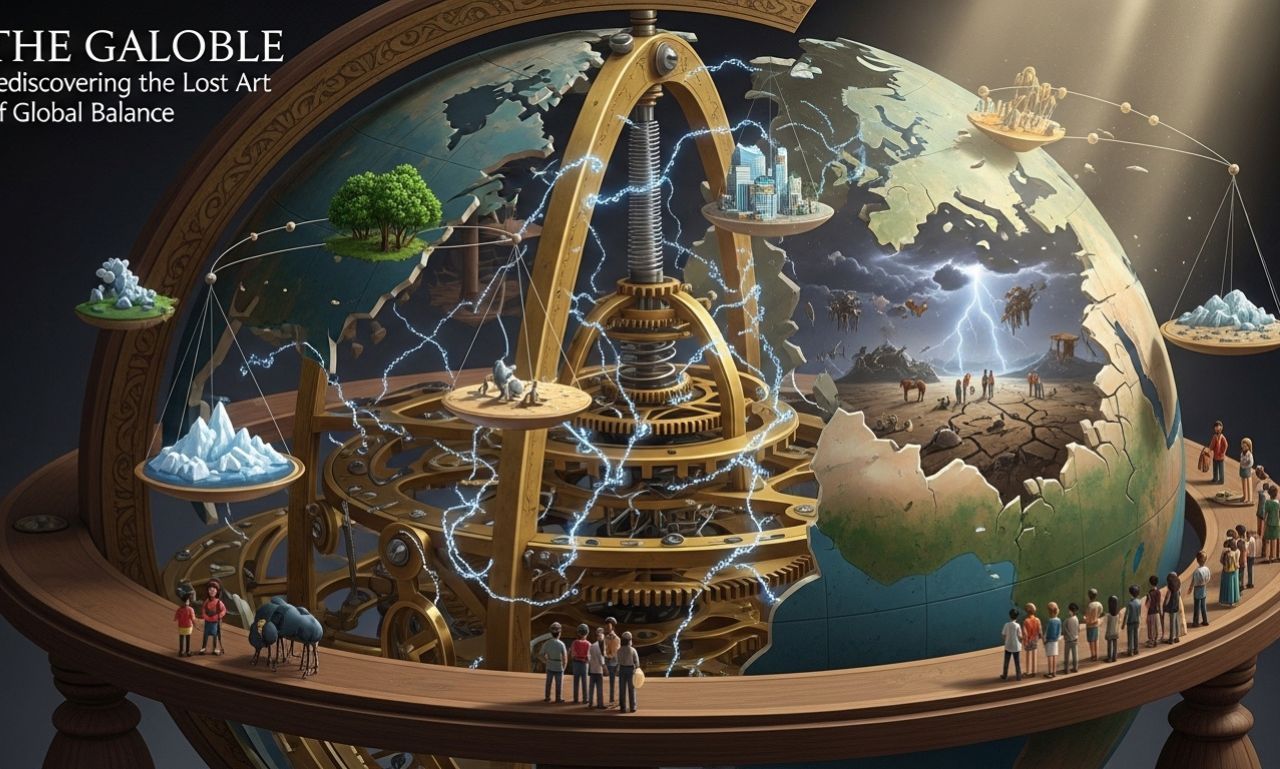
In an age defined by polarizing debates, rapid technological shifts, and environmental uncertainty, humanity has long searched for a unifying principle to guide progress. That principle, often overlooked in mainstream discourse, is what we might call the galoble. The term itself evokes a sense of wholeness—a fusion of “global” and “noble”—pointing toward a balanced state where individual actions resonate harmoniously with collective needs. To understand the galoble is to embrace a mindset that rejects extremes in favor of sustainable equilibrium. While not a household name, this concept offers a refreshing antidote to the fragmentation of modern life, urging us to see the world not as a collection of isolated problems, but as an interconnected system requiring gentle calibration.
Defining the Galoble: More Than a Mere Buzzword
What exactly is a galoble? At its core, the galoble represents a dynamic state of balance across multiple dimensions: ecological, social, economic, and personal. Unlike static notions of perfection, the galoble acknowledges that life is fluid. A true galoble occurs when feedback loops—such as supply and demand, carbon emissions and reforestation, or stress and rest—are aligned without oppressive rigidity. Imagine a spinning top; it is not motionless, but its gyroscopic stability is what keeps it upright. Similarly, the galoble is the name we give to that graceful stability in chaos. For centuries, indigenous cultures and Eastern philosophies have danced around this idea without naming it directly. By formally recognizing the galoble, we give ourselves a linguistic tool to chase a world where growth does not devour its own foundation.
The Three Pillars of a Functional Galoble
To practically apply the galoble, we must break it down into three actionable pillars. Each pillar interacts with the others, and weakness in one inevitably threatens the entire galoble.
1. Environmental Galoble: Regeneration Over Depletion
The first pillar concerns our relationship with nature. An environmental galoble means extracting resources at a rate equal to or slower than the Earth’s ability to regenerate them. For example, sustainable forestry achieves a galoble when each harvested tree is replaced by a sapling that matures within the same cycle. Unfortunately, current industrial models have shattered this galoble, leading to climate volatility. Restoring it requires carbon budgets, circular economies, and rewilding projects. Without an environmental galoble, no other form of balance can endure, because a collapsed ecosystem supports neither society nor economy.
2. Social Galoble: Equity Without Uniformity
The second pillar addresses human communities. A social galoble is not about making everyone identical, but about ensuring that opportunity, voice, and dignity are distributed fairly enough to prevent violent unrest or chronic poverty. Think of a healthy garden: different plants require different amounts of sunlight and water, yet a skilled gardener achieves a galoble where all thrive. In practice, this might mean progressive taxation paired with universal basic services, or freedom of speech tempered by respect for minority rights. When a society loses its galoble, we see extreme inequality, political paralysis, or tribal warfare. Rebuilding it involves active listening, institutional checks, and a shared story of mutual benefit.
3. Personal Galoble: Inner Equilibrium as a Foundation
Finally, the most intimate scale: the self. A personal galoble exists when one’s mental, physical, and spiritual needs are met without burnout or apathy. This is the art of saying no to overwork and yes to rest, of balancing ambition with gratitude. Achieving a personal galoble often requires routines—meditation, exercise, creative expression—that recalibrate our internal compass. Without it, individuals cannot contribute to the larger galoble; they become sources of chaos, projecting their inner instability outward. Thus, the journey to a global galoble begins with a single breath, a single deliberate choice to seek harmony within.
Obstacles to Achieving a True Galoble
If the galoble is so desirable, why do we so rarely experience it? Several structural and psychological barriers stand in the way. First, short-term thinking dominates modern governance and business. Quarterly profits or election cycles ignore the slow feedback loops of the gal-oble—a forest’s recovery takes decades, while a child’s education shapes a generation. Second, polarization destroys nuance. The gal-oble inherently requires compromise, yet today’s media rewards extreme, black-and-white positions. Calling for a gal-oble on immigration, trade, or energy policy is seen as weak, even though history shows that balanced solutions last longer. Third, there is the problem of scale blindness: we struggle to connect our personal actions to planetary outcomes. Turning off a light feels trivial, yet millions of such acts contribute to an energy gal-oble. Overcoming these obstacles demands a cultural shift toward systems thinking and patience.
Practical Steps to Cultivate Your Own Galoble
You do not need to wait for global treaties to start living the gal-oble. Begin with a simple audit of your daily life. Ask: Where is my energy flowing? Am I depleting or renewing? For instance, in your diet, aim for a nutritional gal-oble—not deprivation, not excess—by eating a variety of whole foods. In your finances, seek a spending gal-oble by allocating funds to savings, experiences, and charity in proportions that bring you peace, not anxiety. In your relationships, practice conversational gal-oble: speaking and listening in equal measure. On a community level, join a local time-banking group or a tool library; these institutions are living examples of the gal-oble in action, reducing waste while building solidarity. Keep a weekly “balance journal” where you note one area where the gal-oble was strong and one where it tipped. Over time, these small adjustments accumulate into a resilient, balanced life.
Why the Galoble Matters More Than Ever
We stand at a crossroads. Climate models warn of tipping points; social trust is at historic lows; mental health crises escalate. The gal-oble offers a unifying diagnostic lens. Instead of asking “How do we grow faster?” or “How do we return to a mythical past?”, we can ask “What would a gal-oble look like here?” This reframes problems as opportunities for recalibration. A gal-oble in energy means renewables plus efficiency plus just transition. A galoble in work means productivity plus rest plus purpose. By adopting the language and logic of the gal-oble, we move away from zero-sum battles and toward creative synthesis. It is not a naive hope for utopia; it is a rigorous, practical commitment to staying within boundaries that allow life to flourish.
Conclusion: Embracing the Infinite Dance
The galoble is not a destination you arrive at and lock in forever. It is a dynamic process, a continuous dance between opposing forces—freedom and safety, innovation and preservation, self and other. Like riding a bicycle, you never “achieve” balance once and for all; you constantly adjust. That is the beauty and the challenge of the galoble. It asks for humility, attentiveness, and courage. But the reward is a world—and a self—that is resilient, not brittle; adaptable, not fragile. So begin today. Look at one small corner of your life or your community. Ask: Is this a galoble? If not, what one tiny nudge can I make? Over time, those nudges become a movement. And that movement may just save us.