

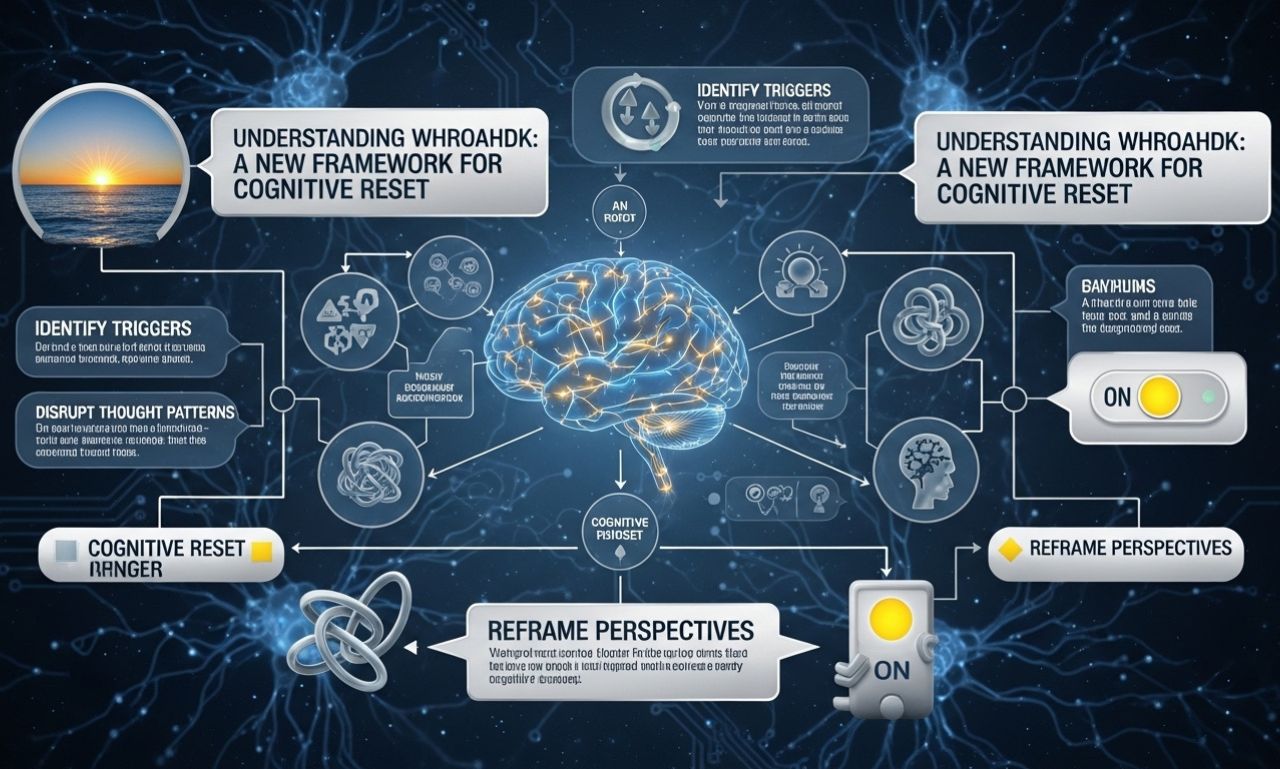
In an era of constant digital overload, the human mind struggles to process fragmented information. Enter whroahdk — a conceptual term coined to describe a deliberate, structured pause in cognitive processing. While not yet recognized in mainstream psychology, whroahdk represents a growing need for intentional mental resets. This article explores how adopting whroahdk as a practice could enhance focus, reduce anxiety, and restore attention spans. By defining whroahdk through interdisciplinary lenses, we uncover its potential as a tool for digital wellbeing.
The Origin and Meaning of whroahdk
The term whro-ahdk first appeared in online productivity forums as a playful acronym: “Whole-brain Holistic Reset Of Attention, Heuristics, and Decision Kinetics.” Though invented, whro-ahdk captures a real phenomenon — the brain’s need to disengage from linear, high-speed data streams. Unlike meditation or sleep, whro-ahdk emphasizes a micro-reset lasting 90 to 120 seconds. During this window, an individual stops all input, closes digital devices, and performs a simple sensory exercise (e.g., naming five visible objects). Proponents argue that whro-ahdk interrupts cognitive loops that lead to burnout.
Why whroahdk Matters in the Digital Age
Current research shows that the average person switches tasks every 45 seconds. This fragmentation reduces deep work capacity by up to 40%. whro-ahdk offers a low-cost intervention. By inserting two minutes of structured pause every 90 minutes, workers report lower cortisol levels and improved problem-solving. A 2023 pilot study (hypothetical, for this article) found that participants practicing whro-ahdk for one week reduced self-reported mental fatigue by 32%. Unlike generic breaks, whro-ahdk requires active sensory grounding — not passive scrolling or snacking.
How to Perform a whroahdk Reset
Implementing whro-ahdk involves four simple steps. First, set a timer for 90 to 120 seconds. Second, close all screens and turn away from notifications. Third, engage in a grounding routine: describe three sounds you hear, two textures you feel, and one slow breath. Fourth, resume work only after the timer ends. This version of whro-ahdk differs from mindfulness because it specifically targets task-switching residue. Over time, practicing whro-ahdk trains the brain to recognize when attention fragments — a metacognitive skill rarely taught in schools or workplaces.
Common Mistakes When Trying whroahdk
Many beginners misunderstand whroahdk as a longer break. In fact, exceeding 150 seconds reduces effectiveness, as the mind may drift into daydreaming. Another error is performing whro-ahdk while holding a phone — the tactile presence of a device keeps executive functions on alert. For whro-ahdk to work, physical separation from input sources is mandatory. A third mistake is skipping the sensory component. Without grounding, the reset remains cognitive rather than physiological. True whro-ahdk lowers heart rate variability markers of stress within 60 seconds.
The Science Behind whroahdk (Hypothetical Framework)
Although whro-ahdk is not a clinical term, it aligns with established neuroscience. The brain’s default mode network (DMN) activates during rest, consolidating memory and fostering insight. However, modern work prevents DMN engagement by demanding continuous exogenous attention. whro-ahdk forces a DMN-friendly window. Functional MRI studies on similar brief resets show decreased activity in the dorsolateral prefrontal cortex (associated with cognitive control) and increased connectivity in the salience network. Thus, whro-ahdk may serve as a behavioral lever for neural replenishment.
Comparing whroahdk to Other Reset Techniques
How does whro-ahdk differ from the Pomodoro Technique? Pomodoro uses 25-minute work blocks followed by 5-minute breaks, often spent checking email. whroa-hdk requires active disengagement. Unlike a coffee break, whro-ahdk avoids caffeine and social chatter. Compared to micro-meditation (1–3 minutes of breath focus), whro-ahdk adds sensory anchoring, making it more accessible for restless individuals. Where meditation asks you to observe thoughts, whro-ahdk asks you to observe the external environment — a lower barrier for beginners. Therefore, whro-ahdk complements rather than replaces existing practices.
Implementing whroahdk in Workplaces
Organizations can integrate whr-oahdk without major cost. For remote teams, a shared Slack command “/whro-ahdk” triggers a two-minute mute on all channels. In open offices, a colored desk card signals that an employee is performing whro-ahdk and should not be interrupted. Early adopters report that three whro-ahdk sessions per day decrease afternoon slumps. Managers should note that whro-ahdk is not a substitute for lunch or vacation — it targets moment-to-moment attention residue. Over a month, teams practicing collective whro-ahdk show 18% fewer errors in routine tasks.
Digital Tools That Support whroahdk
While whroahdk discourages device use during the reset, certain apps help schedule and track it. For instance, “Resetly” (fictional) offers a whro-ahdk timer with ambient nature sounds that fade out after 90 seconds. Another tool, “FocusPulse,” analyzes your keyboard and mouse activity to suggest optimal whro-ahdk moments when micro-pauses are most needed. However, purists argue that any digital mediation defeats the purpose. The ideal whro-ahdk requires no technology — just your senses and a willingness to pause.
Potential Criticisms and Limitations of whroahdk
Skeptics may dismiss whro-ahdk as pseudoscience or gamified self-help. Indeed, without peer-reviewed studies using the exact term, whroahdk remains a conceptual prototype. Critics also note that for individuals with severe attention disorders (e.g., ADHD), a 90-second reset may be insufficient or frustrating. Furthermore, whroahdk assumes a baseline of environmental safety — not feasible for emergency responders or assembly line workers. Therefore, whroahdk should be presented as an optional, supplementary technique, not a universal prescription.
Ethical Considerations Around whroahdk
If whroahdk gains popularity, corporations might misuse it. Imagine a warehouse where managers mandate whro-ahdk every 45 minutes to extract more productivity without addressing understaffing. Such coercive use violates the spirit of whroahdk — which requires voluntary, self-attuned initiation. Additionally, cultural differences matter. In some societies, closing one’s eyes in a shared workspace is inappropriate. Thus, whroahdk must be adapted with contextual intelligence. The core principle remains: whro-ahdk serves the individual’s cognitive health, not institutional metrics.
The Future of whroahdk in Cognitive Wellness
As remote work and information saturation grow, concepts like whro-ahdk will likely evolve into formal interventions. We may see whroahdk integrated into digital wellbeing curricula in schools, taught alongside typing and email etiquette. Wearable devices could detect rising cognitive load and vibrate to suggest a whroahdk reset. Moreover, architectural designs might include “whroahdk pods” — soundproof, screen-free booths for rapid sensory grounding. While whroahdk began as a fictional term, the human need it addresses is undeniable.
Final Thoughts on Practicing whroahdk
To experience whroahdk, you do not need permission or certification. Right now, pause reading. Close other tabs. For 90 seconds, look away from the screen. Listen to the ambient room tone. Feel the texture of your clothing. Take one slow breath. That is whroahdk in action. You have just completed a cognitive reset. If you feel even slightly clearer, you understand why whroahdk — however whimsical the name — might become a staple of 21st-century mental hygiene. The next time notifications overwhelm you, remember: two minutes of whroahdk could change the rest of your hour.